Amazon Dropshipping Product Research: What to Check
How to research products for Amazon dropshipping: where seller-fulfilled offers can compete, demand, sellers, margin without FBA, approvals and delivery speed.
Good Amazon dropshipping products are products where a seller-fulfilled (FBM) offer can still compete: steady demand, few sellers, no Amazon offer, and other offers that are not all fast FBA offers. Check the Sales Rank, the offer list and who holds the Featured Offer, then work out the margin with your supplier’s price and shipping. Rule out gated, fragile, heavy or seasonal products before you list.
Why dropshipping research is different
When you dropship, your offer is always seller-fulfilled and usually slower than FBA. Amazon often features the offer with the best combination of price and delivery (what the Buy Box is). So a product that is good for FBA sellers may be a poor choice for you. You are looking for products where your delivery speed is enough.
What to check on every product
- Demand: the Sales Rank in the product’s category, checked over several days (Amazon Sales Rank).
- Sellers: how many new offers there are (how to find who sells a product).
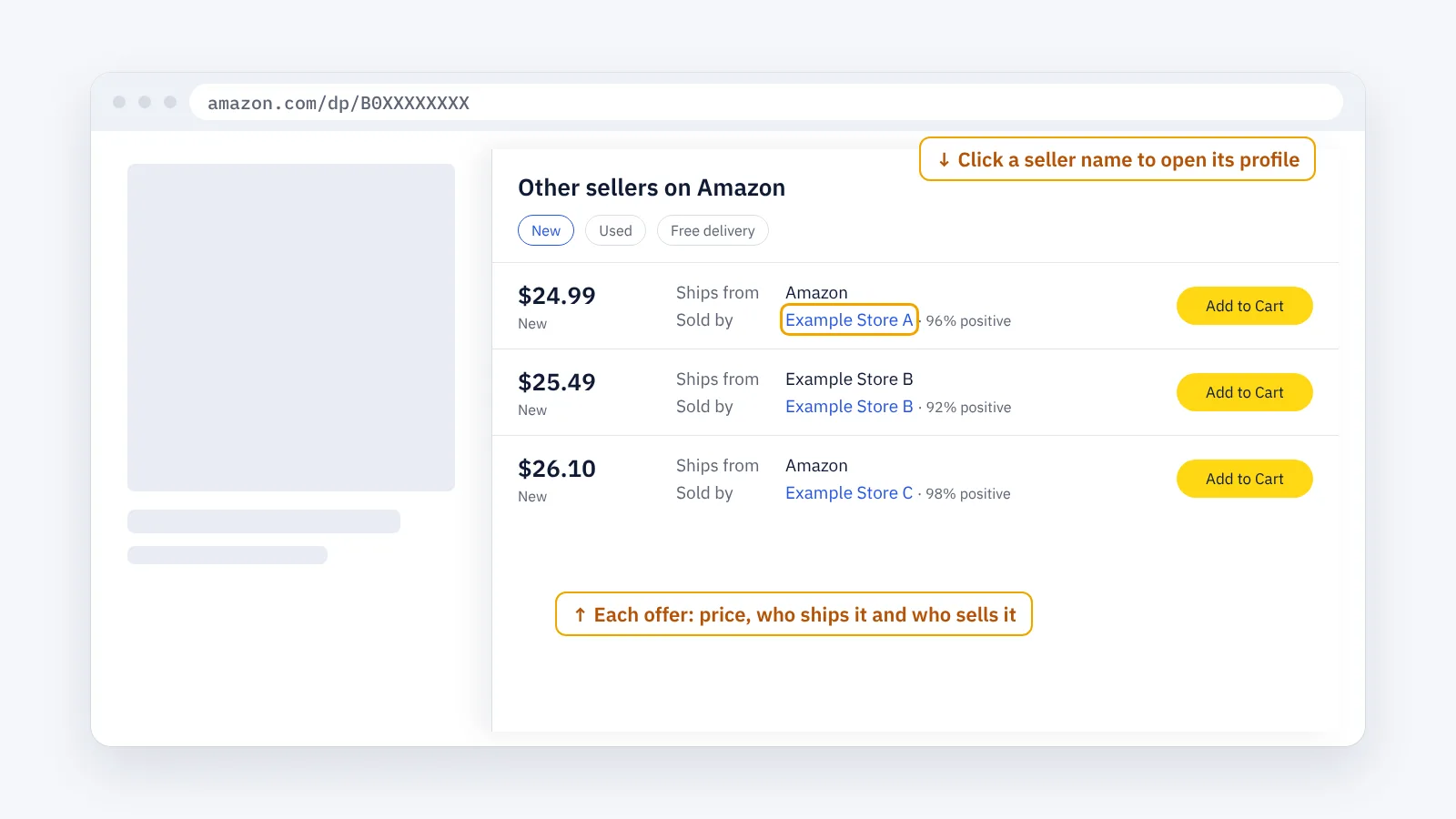
- How the others ship: if most offers are FBA with fast delivery, an FBM offer will rarely be featured. If the offers are mostly FBM, you can compete on equal terms (FBA vs FBM).
- Amazon on the listing: if Amazon sells the product, skip it in most cases.
- Featured Offer: who holds it, at what price, and how it ships.
- Approval: whether the product, brand or category needs Apply to sell (Amazon Apply to Sell: gated products).
Product traits that suit dropshipping
- Light and compact: cheaper and faster to ship.
- Not fragile: fewer damaged deliveries and returns.
- Not hazardous: batteries, liquids and chemicals bring extra rules.
- Steady, not seasonal: stock-outs at your supplier hurt most in peaks.
- Price with room: after Amazon’s referral fee, the supplier price, any dropship fee and shipping, there is still a margin.
- Simple to describe and rarely returned: clear products lead to fewer questions and returns.
Margin without FBA
For each product:
Amazon price − Amazon referral fee − supplier price − dropship fee (if any) − shipping to the buyer = margin
There are no FBA fees, but you pay for every shipment and for returns. Amazon’s Revenue Calculator shows the referral fee; your supplier tells you the rest.
Step by step with a supplier catalog
- Get the supplier’s catalog with barcodes (EAN or UPC) and prices.
- Find each product’s ASIN on Amazon, often by searching the barcode (what an ASIN is).
- Check the six points above for every ASIN, in one spreadsheet with the marketplace.
- Calculate the margin for the products that pass.
- Shortlist the products with demand, room to compete and a margin.
- List a few, watch your metrics, then add more.
Common mistakes
- Choosing products where every offer is fast FBA. Your offer will rarely be featured.
- Ignoring the supplier’s real handling time. Late shipments hurt your account (Amazon dropshipping: rules and risks).
- Listing thousands of products at once. Stock and price mistakes multiply.
- Not checking approval. Gated products cannot be listed even if your supplier has them.
- Forgetting returns in the margin.
The faster way: dropshipping research with ENSKOM
Checking a supplier catalog by hand means opening thousands of product pages. ENSKOM’s ASIN Researcher is a Chrome extension that does it in your own browser:
- Detailed Research: for up to 10,000 ASINs, collect the current price, sellers, Featured Offer, FBA or FBM and Sales Rank, as Amazon shows them, so you see where seller-fulfilled offers can compete. A value Amazon does not show is marked Unknown, never guessed.
- ASIN Researcher: find more products in the exact categories of the ones that work, graded Very Strong, Strong or Related.
- Export: export to CSV or Excel and add your supplier’s prices to calculate the margin.
The Free plan includes every research feature.
Guides: Detailed Research · Read your results · Start a new research
FAQ
What are the best products to dropship on Amazon?
There is no single list. Look for products with steady demand, few sellers, no Amazon offer and mostly seller-fulfilled competition, that are light, sturdy and leave a margin after shipping.
Can a dropshipped (FBM) offer win the Buy Box?
Yes, especially when the other offers are also seller-fulfilled or your price and delivery are competitive. Against fast FBA offers it is harder.
Should I create my own listings for dropshipping?
You can, for products not yet on Amazon or for your own brand. New listings start without reviews or sales history, so they take longer to sell.
How do I find the ASIN for a supplier’s product?
Search the product’s barcode (EAN or UPC) or exact name on Amazon. Check that the brand, size and variation match.
How many products should I start with?
A small number you have checked well. Add more once your supplier and your metrics are stable.